
Fascinating Archaeological Facts on Postage Stamps - 65
2025-07-07 Mon
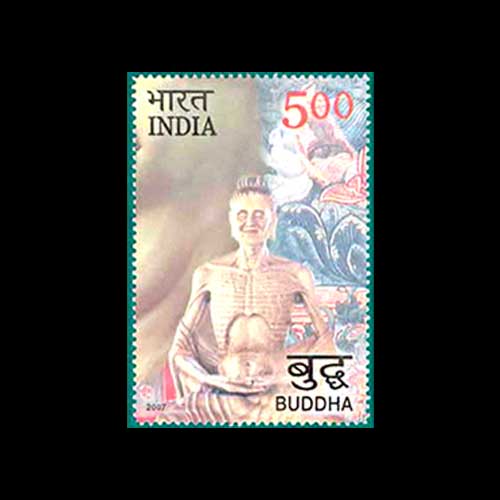
The statue of the Fasting Buddha is one of the finest examples of Gandhara art. Within buddhist tradition, this representation of Buddha conveys the challenges he faced on his journey to achieve enlightenment.Buddhist texts such as the Lalitavistara and Buddhacharita describe how Siddhartha Gautama undertook various ascetic practices in pursuit of Spiritual Awakening. The Abhiniskramana sutras details his determination as he prepared for enlightenment, meditating and fasting for 49 consecutive Days and nights beneath the Bodhi tree in Bodh Gaya, Bihar. During this time, his mouth was closed, his teeth were clenched, and his tongue was positioned against the roof of his mouth. His skin became wrinkled, his body emaciated, and his eyes appeared hollow.
The ancient Indian sculptors from the Gandhara region created the first Stone sculpture of the Fasting Buddha during the 2nd or 3rd century CE. They depicted the Fasting Buddha seated in an emaciated state, with his body resembling a skeletal frame. This statue is currently housed in the Lahore Museum, Pakistan.
Mogali and Abrahams, in their article human anatomy in Ancient Indian Sculptures of Gandhara Art Illustrating the Fasting Buddha" (2017), examined the Fasting Buddha on platforms such as the Google cultural Institute, the British Museum, and the metropolitan Museum. They noted that ancient Indian artists from the Gandhara region had a foundational understanding of human anatomy, including knowledge of the approximate size and position of bones, joints, and muscles. However, they also identified some inaccuracies in anatomical details, such as an extra number of ribs and a segmented sternum.
In India, there is only one sculpture of the Fasting Buddha discovered during excavations in Mathura in the 20th century. It is currently displayed at the Mathura Museum in Uttar Pradesh.
While the statue is widely recognized as the Fasting Buddha, there exists ongoing scholarly debate regarding whether it might more accurately be termed the "Fasting Bodhisattva" or "Fasting Siddhartha," since the figure represents an event preceding the Buddha's enlightenment. On 02 May 2007, India Post issued a series of six commemorative Stamps along with a #miniature sheet to mark the occasion of the 2550th #anniversary of the Mahaparinirvana of the Buddha. Among these stamps is a depiction of the Fasting Buddha sculpture from #Myanmar, with a face value of Rs. 5. Notably, #Buddhism and #hinduism were introduced to Myanmar from India during the first millennium through the efforts of Indian #Traders and priests rather than through #Conquest or #colonization. For additional information about the first stamp from this series, please refer to This Post
Latest News
-
Uttama Chola’s Rare Kahavanu Carries a Tiger beneath the Parasol
2026-08-26 Wed -
A Gangaikonda Series Coin Celebrating Rajendra Chola’s Northern Conquest
2026-08-26 Wed -
Gold Puvitta Anantha Varahan of Travancore Queen Rani Gouri Lakshmi Bayi
2026-08-25 Tue -
A Musician and Composer King's Copper Kasu
2026-08-25 Tue -
Golden “Jaya Chola” on Fanam in Nandinagari Script
2026-08-24 Mon